Key Outcomes
98% Increase in Campaign Engagement
124% Increase in Average Engagement / Post
3 Highest-Performing CST Instagram Posts Since July 2024
Complete Brand & Messaging Framework Created
3 Audience Personas Developed
Carousel Storytelling Strategy Adopted
Context & Challenge
During a period of transition for the National Human Trafficking Hotline, NCMEC recognized a potential decline in reporting related to child sex trafficking. At the same time, misconceptions about the CyberTipline created additional barriers to action, with many survivors, service providers, and members of the public uncertain about what could be reported, whether trafficking needed to involve online activity, or whether definitive proof was required before submitting a report. The challenge was to reduce these barriers by increasing confidence in the reporting process and motivating audiences to act when they suspected a child might be at risk.
Assessment & Strategic Opportunity
Through conversations with survivors, community advocates, and frontline professionals, I identified that the primary barrier to reporting was not a lack of concern, but a lack of confidence. Many potential reporters believed they needed certainty before taking action, misunderstood the role of the CyberTipline, or assumed trafficking had to involve online exploitation. Rather than simply increasing awareness, the opportunity was to redesign the communications strategy around behavior change by combining audience segmentation, clearer calls to action, and more engaging digital storytelling to make reporting feel accessible, actionable, and achievable.
Approach & Execution
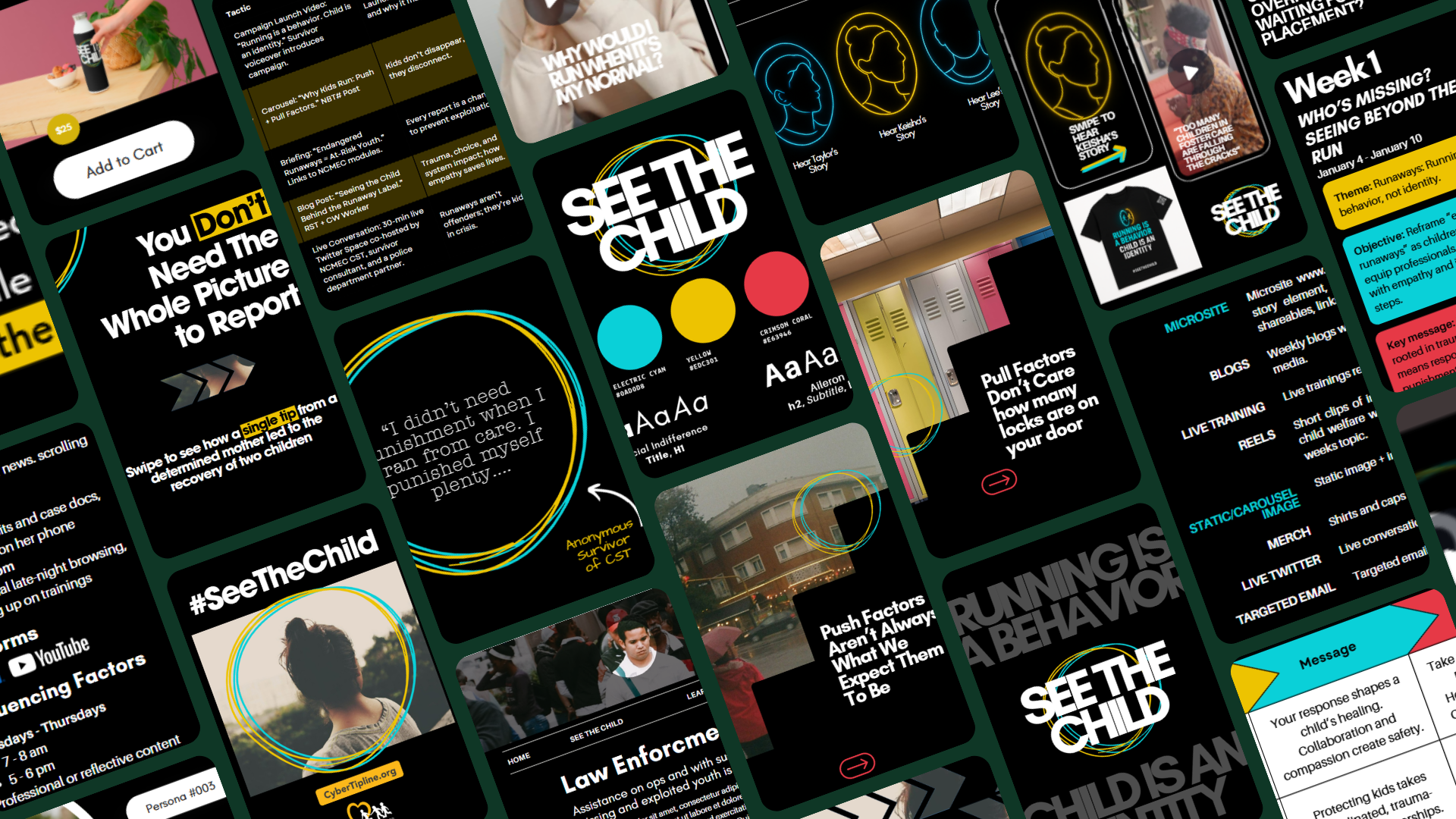
I developed the "See the Child" campaign as a research-driven communications strategy designed to increase reporting and strengthen public understanding of the CyberTipline. The campaign included audience segmentation, messaging architecture, brand development, audience personas, website concepts, content strategies, partner toolkits, and a digital storytelling framework that prioritized behavior change over awareness alone. Tailored messaging, platform strategies, and calls to action were developed for law enforcement, social service professionals, and the general public to address the specific barriers each audience faced. While the full campaign was not implemented, key recommendations—including audience-specific messaging and carousel-based storytelling—were adopted into NCMEC's Human Trafficking Awareness Month communications strategy.
Stakeholder Alignment
I worked closely with division leadership to refine campaign objectives, messaging priorities, and audience strategies while ensuring content remained trauma-informed, action-oriented, and aligned with organizational goals. Survivor experiences informed the campaign's storytelling approach through the adaptation of existing case studies and success stories.
Results & Impact
Although the full campaign was not implemented, several of its core recommendations were incorporated into NCMEC's 2026 Human Trafficking Awareness Month communications strategy, including audience-specific messaging and carousel-based storytelling. Despite publishing two fewer child sex trafficking posts than the previous year, the campaign generated 8,885 engagements (8,618 likes and 267 comments), representing a 98% increase in total engagement and a 124% increase in average engagement per post compared to the 2025 campaign. The three carousel posts introduced through the strategy became the #1, #2, and #4 most-liked child sex trafficking posts across NCMEC's Facebook and Instagram accounts since July 2024, while also ranking #1, #2, and #7 for overall engagement during that same period. The project demonstrates my ability to translate audience research and behavioral insights into communications strategies that influence organizational decision-making, strengthen public engagement, and produce measurable results.