Key Outcomes
194 Applications Received
11 States Represented
11 Survivor Leaders Selected & Trained
2 National Cohorts Completed
4 Op-Eds Authored & Published
1 Nonprofit Launched by Participant
Context & Challenge
The anti-trafficking movement frequently relies on survivor voices, but too often those voices are limited to sharing personal experiences rather than shaping policy, training professionals, or leading systemic change. World Without Exploitation recognized the need to expand survivor leadership capacity across the country by equipping survivors with the skills, confidence, networks, and opportunities necessary to become advocates, trainers, and movement leaders in their own communities.
Assessment & Strategic Opportunity
It has always been clear to me that survivors possess the insight, credibility, and passion to influence policy and drive change, but often lack access to the education, mentorship, and professional networks needed to fully realize their potential. The opportunity was to create a leadership development model that combined skills-based training, mentorship, community-building, and practical experience to cultivate a new generation of survivor leaders.
Approach & Execution
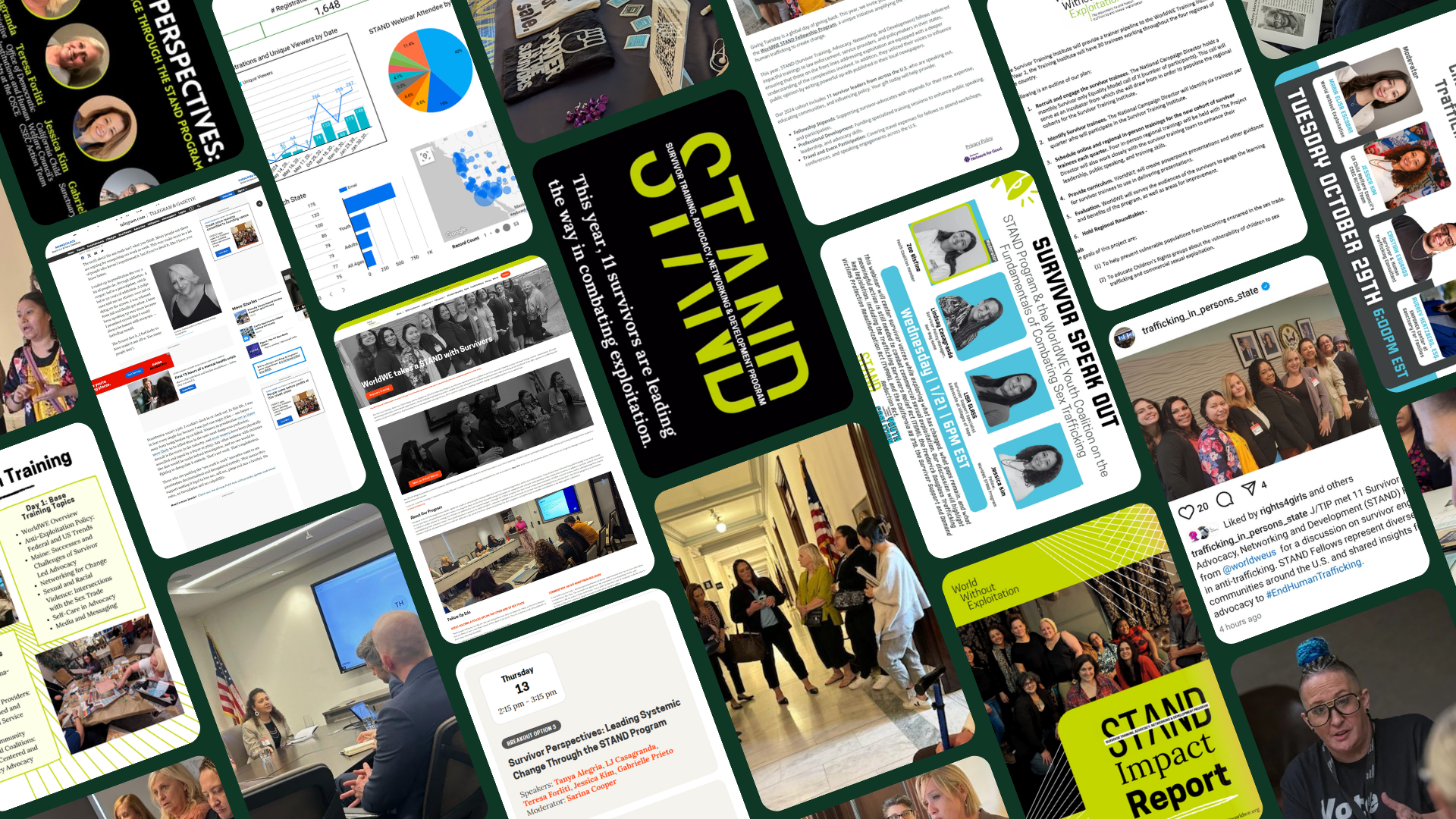
I designed and launched the STAND (Survivor Training, Advocacy, Networking, and Development) program, creating the curriculum, recruitment strategy, application process, participant selection criteria, reporting systems, and training materials. Recruitment efforts through survivor networks, partner organizations, and targeted outreach generated 106 applications for the inaugural cohort and 88 applications for the second.
The program combined intensive training, year-long mentorship, peer learning, and leadership development opportunities focused on policy advocacy, public speaking, media engagement, coalition-building, and systems change. Participants also engaged with national organizations, policymakers, conferences, and stakeholder groups, while the second cohort participated in a national advocacy tour connecting them directly with federal agencies, nonprofit leaders, and decision-makers.
Stakeholder Alignment
The program's success depended on building trust among survivors while cultivating relationships with trainers, policymakers, advocacy organizations, and movement leaders. I developed partnerships from my previous coalition expansion work that expanded learning opportunities, strengthened mentorship networks, and connected participants to meaningful leadership experiences while fostering a supportive peer community that extended beyond the formal program.
Results & Impact
The program received 194 applications across two cohorts and engaged survivors from 11 states in a year-long leadership development experience focused on advocacy, public education, and policy engagement. Participants delivered trainings, engaged with stakeholders, contributed to policy discussions, and expanded survivor-informed leadership within their communities.
The program produced outcomes that extended well beyond the training itself. Two participants authored op-eds, both were published, one participant secured full-time employment in the field, and another launched a nonprofit organization. Most importantly, STAND established a replicable model for developing survivors as advocates, trainers, and movement leaders rather than solely as storytellers.