Key Outcomes
800+ Survivors Connected to Legal Support
550+ Petitions Submitted
50+ Participating Law Firms
25+ Medical & Behavioral Health Providers Engaged
National Survivor Outreach Campaign Launched
Trauma-Informed Legal Support Infrastructure Created
Context & Challenge
In 2025, the Department of Justice announced a limited-time remission process allowing eligible survivors harmed through Backpage to seek financial compensation. While the opportunity represented a significant step toward justice, the process was complex, documentation-intensive, and emotionally demanding for survivors. In response, NCMEC and its partners built a nationwide network of pro bono attorneys, healthcare providers, and service organizations from the ground up. The challenge was to create the communications, engagement, and coordination infrastructure needed to connect survivors with support and help them navigate a time-sensitive legal process.
Assessment & Strategic Opportunity
As applications began to arrive, it became clear that the greatest barriers were not legal, but logistical and communication related. Survivors struggled to navigate documentation requirements, understand legal terminology, and remain engaged through a lengthy process, while many attorneys had limited experience working with trafficking survivors. The opportunity was to create a survivor-centered engagement strategy that translated complex information into accessible guidance, strengthened trauma-informed practices, and reduced barriers to participation.
Approach & Execution
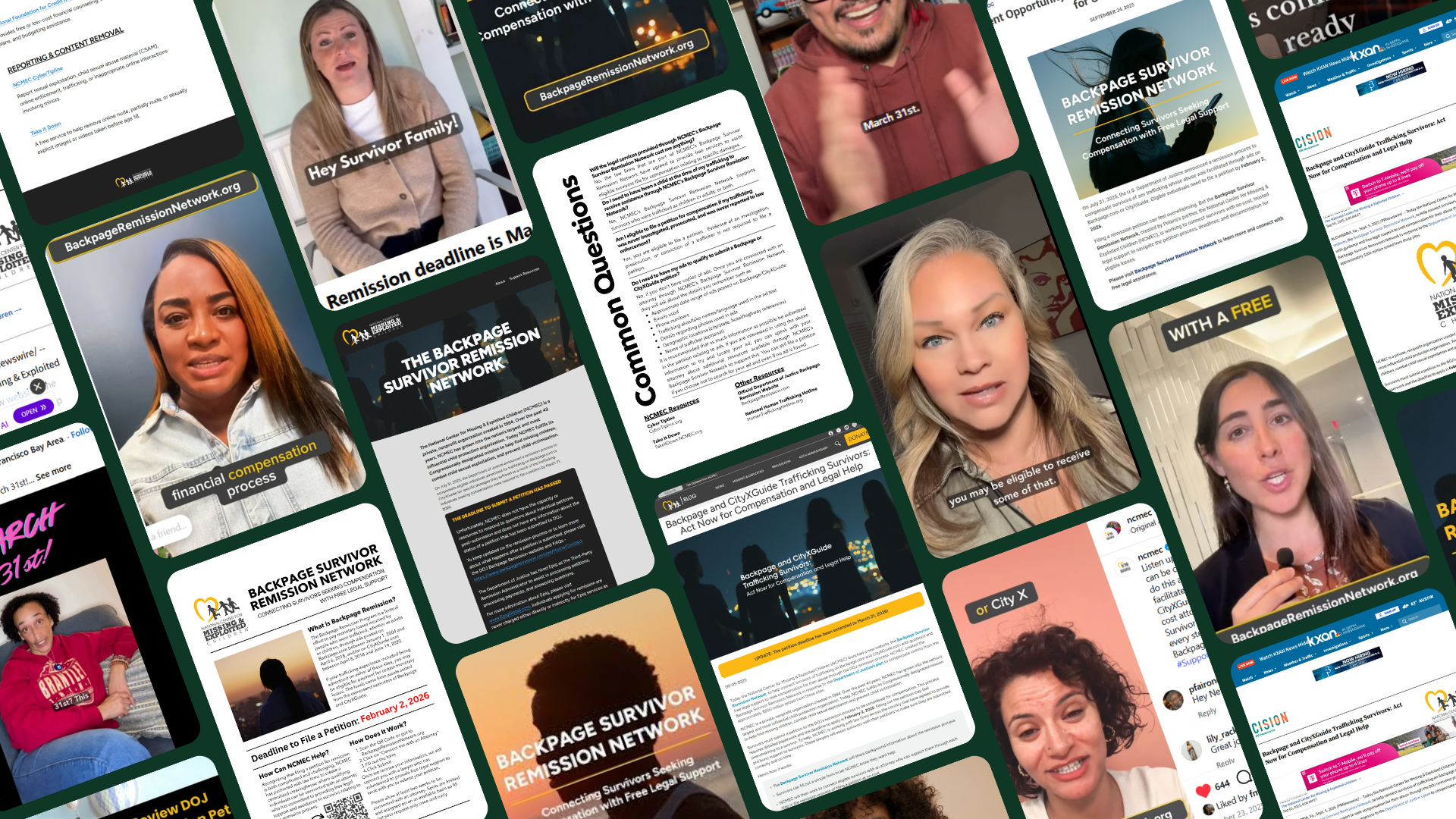
My focus was on building the communications and operational infrastructure needed to support a rapidly growing national network. I developed the survivor-facing website, outreach materials, educational videos, webinars, toolkits, and targeted communication campaigns for survivors, attorneys, service providers, and survivor leaders. To expand awareness, I coordinated outreach through service provider networks, conferences, social media, and survivor-led communications efforts.
As applicants continued to flood in, I created systems to track survivor progress, monitor engagement across more than 50 law firms, and identify individuals at risk of disengaging. I also developed outreach protocols, trauma-informed resources, and communication tools that helped survivors, attorneys, healthcare providers, and NCMEC staff remain aligned throughout the process.
Stakeholder Alignment
The remission network required coordination across survivors, attorneys, healthcare providers, service organizations, and internal teams. I served as a bridge between these groups, translating legal concepts into accessible language for survivors while helping attorneys and partners better understand the realities of trauma and the barriers to engagement they faced. Through webinars, educational resources, office hours, and individualized outreach, I strengthened collaboration across the network and helped participants remain engaged through the process.
Results & Impact
The remission network connected more than 800 survivors with pro bono legal assistance through a nationwide coalition of 50+ law firms and 25 healthcare providers, resulting in more than 550 petitions submitted before the filing deadline. The communications, engagement, and tracking systems developed for the initiative enabled the network to operate at scale while maintaining individualized support, helping survivors successfully navigate a complex and retraumatizing process.