Key Outcomes
2 Bills + 1 Resolution Passed
4 Harmful Bills Blocked
191 Advocacy Actions
124 Survivors Engaged
8 Coalition Partners
1,180+ Professionals Reached
Context & Challenge
Thistle Farms had the credibility, survivor leadership, and national platform to influence policy and systems change, but no formal advocacy function. The organization lacked a policy agenda, engagement strategy, and decision-making framework for evaluating legislative opportunities. The challenge was to build an advocacy department from the ground up and create the infrastructure necessary to translate mission into policy impact.
Assessment & Strategic Opportunity
A quick review of the organization revealed that the barrier was not a lack of influence, but a lack of structure. Thistle Farms already possessed trusted relationships, engaged supporters, and a strong survivor community. The opportunity was to transform those assets into a coordinated advocacy function through clear priorities, strategic decision-making, and meaningful engagement pathways.
Approach & Execution
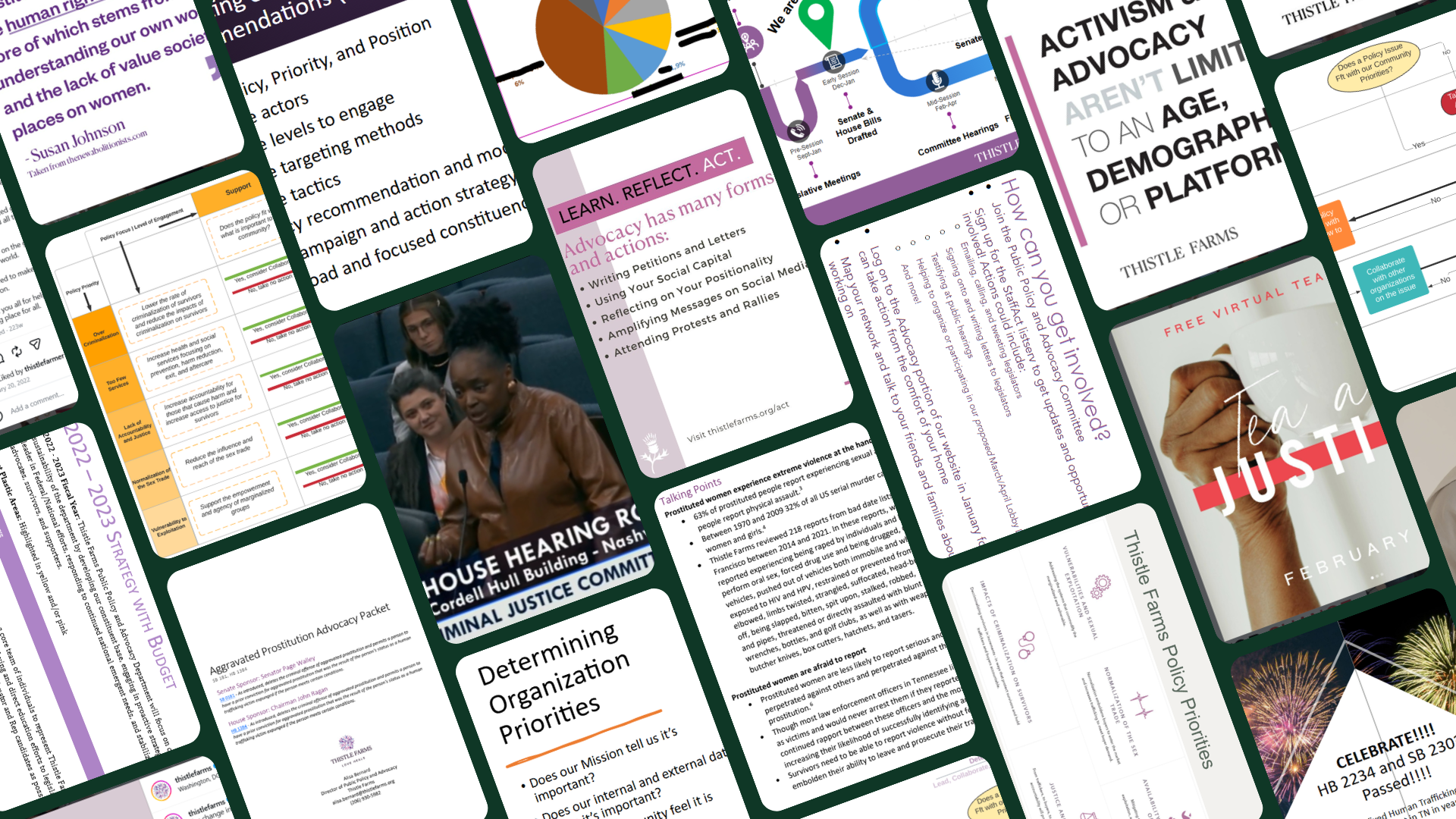
I established the governance structures, systems, and processes necessary to support a sustainable advocacy function. Through stakeholder interviews, surveys, focus groups, and organizational analysis, I developed a five-priority policy agenda and a framework for evaluating advocacy investments. I then built the operational infrastructure required to execute the work, including legislative tracking, campaign planning, stakeholder engagement, and reporting systems.
With that foundation in place, I developed advocacy campaigns, policy briefs, engagement toolkits, and legislative outreach strategies to advance priority initiatives. I also convened a coalition of nonprofit and government partners, built relationships with policymakers across the political spectrum, and coordinated successful campaigns focused on expungement reform, repeal of Tennessee's aggravated prostitution law, expansion of survivor record relief, and opposition to harmful legislation.
Stakeholder Alignment
Building these frameworks and functions required engagement across staff, board members, survivors, coalition partners, and policymakers. I created structured opportunities for participation through focus groups, a policy working group, regular communications, and tiered advocacy pathways that allowed stakeholders to engage at the level they felt comfortable with. Through direct outreach and relationship-building, I conducted more than 100 meetings with legislators during my first year while expanding survivor, staff, board, and partner participation in advocacy efforts.
Results & Impact
Within two years, Thistle Farms evolved from having no formal advocacy infrastructure to operating a coordinated policy and public affairs function capable of advancing legislative priorities, mobilizing stakeholders, and influencing legislation. Advocacy efforts contributed to the passage of two Tennessee laws, including repeal of the aggravated prostitution statute and expansion of survivor record relief, as well as a legislative resolution protecting survivors.
Beyond legislative outcomes, the organization activated 124 survivors who collectively took 191 policy actions, established a coalition of eight nonprofit and government partners, endorsed three federal bills, and presented at 12 national events reaching more than 1,180 individuals. Most importantly, Thistle Farms gained the strategy, systems, relationships, and organizational confidence necessary to sustain advocacy work beyond my tenure.